
Fintech Infrastructure Trends Every Founder Should Know!
The New Awesome Core of Fintech
Fintech infrastructure has moved from being a back-office concern to the strategic core of competitive advantage for financial innovators worldwide. Founders building in the United States, Europe, Asia or Africa now operate in an environment where regulatory scrutiny has intensified, capital has become more selective, and customer expectations have been shaped by near-instant, always-on digital experiences. In this context, the architecture beneath a product is no longer merely a technical decision; it defines the scalability of business models, the credibility of risk management, the resilience of operations and the long-term valuation of the company. For readers online right now and the broader ecosystem of founders, investors and executives who follow developments across fintech, business and the global economy, understanding these infrastructure shifts has become a prerequisite for informed strategic planning rather than a specialist concern delegated to engineering teams.
As regulators from the U.S. Securities and Exchange Commission and European Central Bank to the Monetary Authority of Singapore intensify their focus on operational resilience and data governance, and as large incumbents such as JPMorgan Chase, HSBC, BNP Paribas and Goldman Sachs open up more of their capabilities through APIs and cloud partnerships, founders must navigate a landscape where the boundary between "tech company" and "regulated financial institution" is increasingly blurred. The most successful fintechs emerging in 2026 are those that treat infrastructure not as a cost center but as a strategic asset that can be leveraged for faster market entry, more efficient compliance, better risk-adjusted returns and differentiated customer experiences across both developed markets such as the United States, United Kingdom, Germany and Japan, and rapidly digitizing economies in Africa, South America and Southeast Asia.
From Monoliths to Composable, API-First Architectures
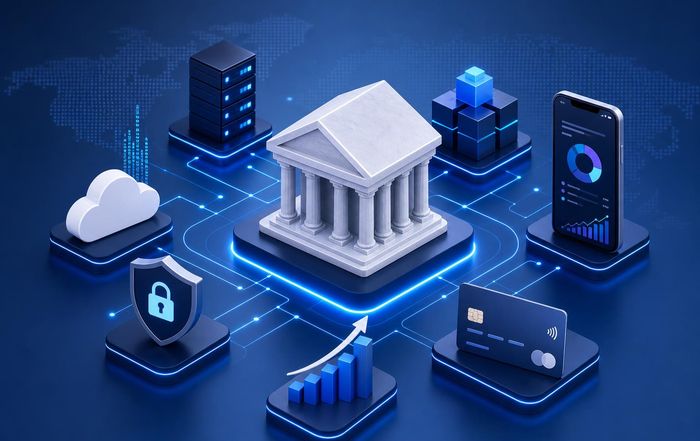
One of the defining infrastructure trends shaping fintech in 2026 is the industry-wide shift from monolithic systems to composable, API-first architectures. Instead of building vertically integrated stacks that own every component from onboarding and KYC to ledgering, payments, risk and reporting, founders are increasingly orchestrating best-of-breed modules from specialized providers, connecting them via standardized interfaces and focusing their internal engineering resources on differentiation at the product and user-experience layers. This evolution mirrors broader software trends described by organizations such as the Cloud Native Computing Foundation, and founders who understand cloud-native design patterns can accelerate their roadmap while maintaining strong reliability and security.
In practice, composability means a startup launching in Canada, Singapore or Brazil can assemble core banking capabilities from a modern ledger provider, integrate payments through global networks like Visa and Mastercard, embed identity verification from a regulated KYC platform and layer on analytics using cloud data warehouses, all while maintaining a coherent view of the customer and complying with local regulations. Resources such as the Bank for International Settlements guidance on open finance and digital infrastructure help founders understand the regulatory expectations that accompany this modularity. For readers of FinanceTechX, which regularly profiles founders building in different regions, this shift has been visible in the way new entrants talk about "orchestration" rather than "owning the stack," and in the proliferation of infrastructure-as-a-service providers that target specific layers of the financial value chain.
This architectural change has profound implications for time-to-market and capital efficiency. Instead of spending two or three years and tens of millions of dollars building a proprietary core, a team in London or Sydney can launch a regulated product in months by relying on Banking-as-a-Service partners and cloud-native cores, subject to careful vendor due diligence and contingency planning. At the same time, composability introduces new integration risks, vendor lock-in considerations and data residency challenges, particularly in jurisdictions such as the European Union where the European Data Protection Board enforces strict interpretations of GDPR. Founders must therefore design integration layers and data models that can adapt to regulatory changes and vendor churn, ensuring they retain control over the most critical parts of their infrastructure even as they embrace modularity.
Cloud, Multi-Cloud and Sovereign Infrastructure
Cloud computing has been a defining enabler of fintech growth over the past decade, and by 2026 the conversation has shifted from "whether" to use cloud to "how" to do so in a way that satisfies regulators, customers and investors across multiple jurisdictions. Major providers such as Amazon Web Services, Microsoft Azure and Google Cloud now offer dedicated financial-services clouds, with specialized security controls, compliance certifications and data-residency options that align with guidance from authorities like the U.S. Federal Reserve, the European Banking Authority and the Financial Conduct Authority in the United Kingdom. Founders can explore best practices through resources such as the Basel Committee on Banking Supervision publications on outsourcing and operational resilience, which have become required reading for infrastructure leaders in regulated fintechs.
The rise of multi-cloud and sovereign cloud strategies is particularly relevant for companies operating across Europe, Asia and North America, where data localization rules and geopolitical tensions influence infrastructure decisions. In markets like Germany, France and the Netherlands, banks and fintechs are increasingly turning to EU-hosted or sovereign cloud offerings to ensure compliance with local supervisory expectations, while in regions such as South Korea and Japan regulators closely monitor cross-border data flows. This is not purely a compliance issue; it affects latency, user experience and the ability to deliver real-time services to customers in different geographies. For an audience following the global landscape on FinanceTechX World, these developments illustrate how infrastructure choices are now deeply intertwined with macroeconomic and political dynamics.
Multi-cloud adoption is also driven by operational resilience concerns, as regulators in the United States, United Kingdom and European Union increasingly warn about concentration risk in critical cloud providers. Founders must therefore design architectures that can fail over between providers or at least mitigate the impact of a single-cloud outage, without incurring unsustainable complexity or cost. This requires robust observability, standardized deployment pipelines, and a careful balance between portability and the use of proprietary cloud services that can accelerate development. The most sophisticated fintechs are investing in platform engineering teams that abstract cloud complexity away from product squads, aligning with the emerging best practices documented by organizations such as the Linux Foundation and OpenSSF, while still maintaining the agility that has historically differentiated fintech from incumbent financial institutions.
AI-Native Infrastructure and Intelligent Financial Services
By 2026, artificial intelligence has moved from experimental pilots to a foundational layer of fintech infrastructure, shaping everything from credit underwriting and fraud detection to customer support and portfolio optimization. The emergence of powerful foundation models, coupled with advances in vector databases, streaming data platforms and privacy-preserving machine learning, has enabled fintechs to deliver highly personalized, context-aware services at scale. Readers exploring AI's impact on finance on FinanceTechX will recognize that the most competitive players now treat AI not as a single feature but as an architectural principle, designing data flows and system boundaries to support continuous learning and real-time decisioning.
Founders must pay close attention to the evolving regulatory environment around AI, as authorities such as the European Commission with its AI Act, the U.S. Consumer Financial Protection Bureau, and the UK Information Commissioner's Office increasingly scrutinize automated decision-making in credit, insurance and payments. Guidance from organizations like the OECD on trustworthy AI and frameworks from the World Economic Forum on responsible AI in financial services provide valuable reference points for designing compliant and ethical systems. Infrastructure that supports model explainability, audit trails, bias detection and human-in-the-loop review is no longer optional for fintechs operating in lending, wealth management or insurance across the United States, Europe and Asia.
Technically, AI-native infrastructure requires robust data engineering pipelines that can ingest, clean and transform data from multiple sources, including transaction histories, alternative data, open banking feeds and external risk signals. Real-time processing frameworks such as Apache Kafka, Flink or cloud-native equivalents allow fintechs to detect fraud patterns as they emerge, dynamically adjust credit limits or personalize offers in milliseconds. At the same time, privacy and security constraints demand techniques such as differential privacy, federated learning and secure enclaves, particularly when operating in regions like the European Union and Canada where data protection regimes are stringent. The challenge for founders is to integrate these capabilities without overwhelming their teams or compromising the clarity of their product roadmap, which is why many are turning to specialized AI infrastructure providers that offer managed platforms aligned with financial-sector requirements.
Embedded Finance and the Rise of Financial Infrastructure as a Service
Embedded finance has grown from a buzzword to a dominant distribution model by 2026, with non-financial brands across retail, mobility, SaaS and marketplaces integrating payments, lending, insurance and investment products directly into their customer journeys. This shift has created a massive demand for infrastructure-as-a-service providers that can handle licensing, compliance, risk and core processing on behalf of brands, while exposing simple APIs and SDKs. For readers of FinanceTechX tracking business model innovation, this evolution has redefined what it means to be a fintech founder: many of the most successful new entrants no longer operate consumer-facing apps, but instead power financial capabilities behind the scenes for companies across North America, Europe, Asia and beyond.
Global consultancies such as McKinsey & Company and Boston Consulting Group have documented the scale of this opportunity, highlighting how embedded finance can increase customer lifetime value and open new revenue streams for non-financial businesses. However, the infrastructure required to deliver these services reliably and compliantly is complex, involving multi-tenant architectures, partner onboarding workflows, configurable risk rules and settlement processes that span multiple jurisdictions and currencies. Founders building in this space must navigate licensing regimes overseen by regulators like the Office of the Comptroller of the Currency in the United States, the BaFin in Germany, and the Australian Prudential Regulation Authority, often through partnerships with sponsor banks that provide regulatory cover but also impose stringent oversight.
For platforms that choose to embed financial services rather than become providers themselves, the key infrastructure decision lies in selecting partners whose technology, risk appetite and regulatory posture align with their long-term strategy. Due diligence goes beyond API documentation to include assessments of capital strength, compliance track record, information security and business continuity planning. As covered regularly in FinanceTechX news and banking sections, recent enforcement actions and high-profile outages have underlined the reputational and financial risks of weak infrastructure in embedded finance chains, prompting boards and investors to ask more detailed questions about vendor selection and operational resilience.
Cybersecurity, Zero-Trust and Regulatory Expectations
Security has always been central to financial services, but the threat landscape facing fintechs in 2026 is more complex and global than ever. Ransomware groups, state-linked actors and sophisticated fraud rings target companies across the United States, United Kingdom, Europe, Asia and Africa, exploiting supply-chain vulnerabilities, social engineering and misconfigured cloud resources. Regulatory bodies such as the U.S. Cybersecurity and Infrastructure Security Agency, the European Union Agency for Cybersecurity (ENISA) and the UK National Cyber Security Centre regularly issue alerts specific to the financial sector, while frameworks like NIST's cybersecurity guidelines and ISO 27001 have become baseline expectations for fintech infrastructure. Founders must design with a zero-trust mindset from day one, assuming that any component, user or network segment could be compromised and requiring continuous verification and least-privilege access.
For the FinanceTechX audience, which frequently engages with topics at the intersection of security, jobs and talent, this shift has direct implications for hiring and organizational design. Infrastructure and platform engineers must collaborate closely with security and compliance teams, embedding controls into CI/CD pipelines, implementing robust secrets management, enforcing strong identity and access management, and monitoring production environments with advanced detection and response capabilities. Industry groups such as the Financial Services Information Sharing and Analysis Center (FS-ISAC) provide valuable intelligence and best practices for defending against sector-specific threats, and increasingly, investors in late-stage fintech rounds expect to see active participation in such initiatives as evidence of maturity and seriousness.
Regulators across regions are also tightening incident reporting requirements, mandating that significant cyber events be disclosed within strict timeframes and that firms demonstrate clear playbooks for response and recovery. This has elevated disaster recovery, backup strategies and chaos engineering from technical afterthoughts to board-level concerns. Founders need to ensure that their infrastructure can withstand not only targeted attacks but also cloud outages, third-party failures and human error, and that they can restore critical services quickly without data loss or regulatory breaches. The trust of customers, partners and regulators depends on this resilience, and as FinanceTechX continues to cover high-profile security incidents and their fallout, the market is rewarding those fintechs that treat cybersecurity as an integral part of their value proposition rather than a checkbox exercise.
Data Infrastructure, Open Finance and Real-Time Economies
The evolution of data infrastructure is another defining trend that every fintech founder must understand in 2026. With the maturation of open banking and the emergence of broader open finance regimes in markets such as the United Kingdom, European Union, Australia, Brazil and Singapore, fintechs now have access to rich, consented data streams that can power more accurate risk models, personalized financial advice and innovative products that cut across traditional sector boundaries. Initiatives like the UK Open Banking Implementation Entity, the European Commission's work on PSD3 and the Australian Competition and Consumer Commission's Consumer Data Right provide blueprints for how data portability and interoperability are reshaping financial infrastructure. For readers following economy and stock-exchange dynamics on FinanceTechX, the shift toward real-time data flows is transforming how markets, payments and risk are managed.
To harness these opportunities, fintechs must invest in scalable, secure and well-governed data platforms that can handle both batch and streaming workloads. Cloud-native data warehouses and lakehouses, combined with event-driven architectures, allow firms to integrate transaction data, third-party APIs, behavioral analytics and external signals such as macroeconomic indicators from sources like the International Monetary Fund or World Bank. This integrated view underpins use cases ranging from instant credit decisions and dynamic pricing to real-time treasury management for corporate clients. At the same time, data governance frameworks must ensure compliance with privacy regulations, customer consent management, retention policies and data quality standards, aligning with best practices advocated by organizations like the EDPB and national data-protection authorities.
The move toward real-time economies is particularly visible in payments and capital markets. Instant payment schemes such as FedNow in the United States, SEPA Instant in Europe and fast-payment systems in markets like India, Brazil and Singapore require infrastructure that can process and reconcile transactions 24/7 with near-zero downtime. Similarly, the increasing electronification of trading across asset classes, combined with the rise of digital assets and tokenized securities, demands low-latency, high-throughput systems that can integrate with multiple venues and post-trade infrastructures. Founders must therefore think carefully about database choices, messaging systems, caching strategies and observability tools to ensure their platforms can support these demanding workloads without compromising consistency or auditability.
Digital Assets, Tokenization and Regulated Crypto Infrastructure
While speculative cycles in crypto markets have cooled since their peaks earlier in the decade, digital assets and tokenization have firmly embedded themselves in the financial infrastructure landscape by 2026. Central banks from the People's Bank of China to the European Central Bank and Bank of England continue to explore or pilot central bank digital currencies, while regulators such as the U.S. Commodity Futures Trading Commission and European Securities and Markets Authority refine frameworks for stablecoins, security tokens and digital asset service providers. For founders and readers interested in crypto and digital markets on FinanceTechX, the key trend is the institutionalization of infrastructure: custody, trading, settlement and compliance systems that meet the standards of traditional capital markets while leveraging the programmability and transparency of blockchain technology.
Tokenization of real-world assets, including bonds, equities, real estate and alternative investments, is gaining traction across Europe, Asia and North America, supported by initiatives from major exchanges and custodians. This creates opportunities for fintechs that can provide compliant issuance platforms, regulated custody, on-chain analytics and integration layers between distributed ledgers and legacy core banking or brokerage systems. However, the infrastructure challenges are non-trivial, involving key management, smart-contract security, interoperability between chains, and alignment with existing regulations on investor protection, market abuse and anti-money-laundering. Guidance from bodies such as the Financial Action Task Force on virtual assets and the International Organization of Securities Commissions on crypto-asset markets is essential reading for any founder entering this domain.
For FinanceTechX, which also covers green fintech and environment topics, another emerging dimension is the use of blockchain-based infrastructure for sustainability-linked finance and carbon markets. Projects that tokenize carbon credits or sustainability claims must build robust verification, reporting and governance mechanisms, ensuring that on-chain representations correspond to real-world outcomes and comply with evolving standards from organizations like the Task Force on Climate-related Financial Disclosures and the International Sustainability Standards Board. Founders who understand both the technical and regulatory dimensions of this space can position themselves at the intersection of fintech innovation and global efforts to transition to a low-carbon economy.
Talent, Governance and the Founder's Infrastructure Playbook
Infrastructure trends are ultimately shaped not just by technology and regulation but by people and governance. For founders building in 2026, whether in New York, London, Berlin, Toronto, Singapore, Nairobi or São Paulo, the ability to attract and retain experienced platform engineers, security specialists, compliance officers and product leaders with deep financial-services expertise is a decisive factor in executing on ambitious roadmaps. As the hard-working, editorial team regularly highlights in its original reporting of jobs and careers and education, the competition for this talent is intense, and the most successful companies are those that invest early in clear architectural principles, documentation, mentoring and cross-functional collaboration between technology, risk and business teams.
Governance structures must evolve alongside infrastructure complexity. Boards and executive teams need clear visibility into technology risk, vendor dependencies, security posture and regulatory compliance, supported by metrics and dashboards that translate technical realities into business-relevant insights. Frameworks from organizations such as the Institute of International Finance and the Global Financial Markets Association can help boards understand their oversight responsibilities in areas like operational resilience, cloud risk and AI governance. Founders should ensure that infrastructure leaders have a voice at the strategic table, as decisions about cloud providers, data architectures, AI platforms and embedded finance partnerships have long-term implications for valuation, regulatory relationships and exit options, whether via IPO, acquisition or strategic partnership with incumbents.
For the entrepreneur community, which spans founders, investors, executives and policymakers, the message is clear: fintech infrastructure is no longer a background concern but a primary driver of competitive differentiation, regulatory trust and sustainable growth. As capital markets reward durable, compliant and resilient business models over pure growth at any cost, the companies that will define the next decade of financial innovation are those that treat infrastructure as a strategic discipline, invest in the right talent and partnerships, and continuously adapt to the evolving technological and regulatory landscape. Founders who internalize these trends and align their architecture with their business ambitions will be best positioned to build enduring institutions that shape the future of finance across the United States, Europe, Asia, Africa, South America and beyond, and FinanceTechX will continue to chronicle their journeys as they redefine what is possible in global financial services. Thank you for taking the time to read in depth. There is always more context, more perspective, and more discovery waiting ahead.
