
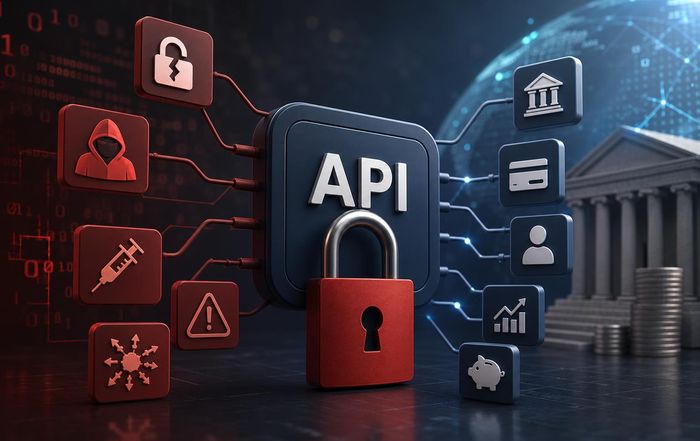
Common API Security Risks in Fintech Integrations
APIs sit at the center of modern finance. Open banking, embedded payments, robo-advisors, and digital lending all rely on tightly interconnected systems sharing sensitive financial data in real time. That connectivity powers innovation, but it also expands the attack surface dramatically. For fintechs, banks, and third-party providers, understanding the most common API security risks is no longer optional; it is a prerequisite for operating in a regulated, high-stakes environment.
This feature examines the main API security pitfalls that arise in fintech integrations, why they are uniquely dangerous in financial contexts, and how organizations can reduce their exposure without slowing product development. It draws on guidance from regulators, industry bodies, and security standards such as OWASP, NIST, and ISO to frame practical, technology-agnostic lessons for teams building or consuming financial APIs.
Along the way, readers may find it useful to explore related reporting on areas such as fintech infrastructure and innovation, banking transformation, AI in financial security, cybersecurity trends, and crypto and digital assets.
Why API Security Is Different in Financial Services
APIs underpin everything from consumer banking apps to institutional trading platforms, but financial APIs carry risks that go beyond typical data breaches. A compromise can enable direct theft of funds, unauthorized loans, market manipulation, or fraudulent transactions that propagate across multiple institutions. Because fintech ecosystems are highly interconnected-banks, payment processors, card networks, data aggregators, and regtech providers-one weak link can expose many others.
Regulators have recognized this systemic risk. Frameworks such as the EU's PSD2 and Open Finance proposals, the UK's Open Banking standards, and similar initiatives in markets like Singapore and Australia are built around API-driven data sharing. At the same time, supervisory bodies such as the European Banking Authority and the U.S. Federal Financial Institutions Examination Council emphasize that banks remain accountable for third-party risk, even when services are delivered via external APIs. Global standards from NIST and ISO reinforce the expectation that APIs are treated as first-class security assets, not mere implementation details.
Fintechs often move faster than traditional institutions, adopting microservices, serverless architectures, and continuous deployment. That speed can conflict with the rigorous testing, documentation, and change control expected in regulated environments. In practice, many API vulnerabilities arise not because the underlying cryptography is weak, but because of design oversights, inconsistent access controls, or gaps in monitoring that attackers can chain together.
Against that backdrop, the following sections examine the most common and consequential API security risks in fintech integrations, using the OWASP API Security Top 10 as a useful-but not exhaustive-reference point.
Broken Authentication and Weak Session Management
Weak or inconsistent authentication is one of the most dangerous API flaws in finance because it can convert a single vulnerability into direct account takeover. Broken authentication covers a spectrum of issues: missing multi-factor authentication (MFA) for sensitive operations, weak or predictable API keys, improper handling of OAuth tokens, and session identifiers that can be guessed, reused, or stolen.
In many open banking and embedded finance scenarios, APIs rely on OAuth 2.0 and OpenID Connect flows to delegate access between a bank, a third-party provider, and an end user. Implementations that deviate from best practices-for example, not using the authorization code with PKCE, misconfiguring redirect URIs, or failing to validate token signatures-can allow attackers to obtain tokens that grant access to accounts they do not own. Guidance from organizations such as the OpenID Foundation and IETF highlights how subtle misconfigurations can invalidate the security guarantees that OAuth is supposed to provide.
Session management problems are equally critical. If mobile banking apps or fintech dashboards store tokens in insecure local storage, fail to implement proper session expiration, or do not rotate tokens on privilege elevation, malware or device theft can lead to long-lived, hard-to-detect compromises. In B2B fintech integrations, static API keys shared by email or embedded in configuration files can be exfiltrated from code repositories or logs, giving attackers persistent access to high-value back-office APIs.
Mitigation requires a combination of strict technical controls and disciplined operational practices. Enforcing MFA for high-risk actions, using short-lived access tokens with refresh tokens, binding tokens to specific clients and scopes, and rotating secrets regularly are table stakes. Aligning implementations with standards and testing them against the latest recommendations from bodies like NIST and OWASP reduces the likelihood that a well-intentioned implementation choice becomes a systemic vulnerability.
Excessive Data Exposure and Privacy Leakage
APIs often return more data than is strictly necessary, relying on the client to filter what is displayed. In consumer applications this can be a performance concern; in financial APIs, it can become a compliance and privacy problem. Excessive data exposure occurs when an endpoint returns full customer records, historical transactions, or internal identifiers even though a specific integration only needs a subset.
In open banking, for example, a data aggregation API that retrieves account balances might also return personally identifiable information (PII), full transaction descriptions, merchant identifiers, or internal risk scores. Even if the third-party consumer does not show this data in its UI, it may log or store it, increasing the blast radius in the event of a breach. Regulations such as the EU's GDPR, Brazil's LGPD, and various data protection laws in Asia and North America impose strict requirements on data minimization and purpose limitation. Over-permissive APIs make it difficult to demonstrate compliance.
From a security perspective, excessive exposure gives attackers more material to work with. Detailed error messages and rich payloads can reveal internal account IDs, system architecture, or business logic that can be exploited in later stages of an attack. In fraud scenarios, access to granular transaction metadata can help adversaries craft convincing social-engineering lures or test small-value transactions that evade detection.
The defensive pattern is to design APIs around least privilege and explicit data contracts. That means creating separate endpoints or views for different use cases, enforcing field-level security based on user roles, and using schema validation to ensure that only the intended attributes are returned. Banks and fintechs that publish developer portals should clearly document what data each endpoint exposes and align it with regulatory expectations, similar to how official open banking frameworks in some jurisdictions define standardized scopes and data clusters.
Broken Object Level Authorization (BOLA) and Insecure Direct Object References
Broken Object Level Authorization-sometimes known as insecure direct object references (IDOR)-is one of the most prevalent API vulnerabilities identified by OWASP. It occurs when an API correctly authenticates a user but fails to verify that the user is authorized to access a specific resource. In fintech, that might mean a user can change a path parameter or identifier in a request to retrieve or modify another customer's account, transaction, or document.
Because financial APIs are often highly parameterized-for example, /accounts/{accountId}/transactions-developers may assume that checking the user's authentication status is sufficient. If the back-end then fetches the requested resource solely based on the provided ID, an attacker can iterate over IDs or intercept and modify API calls to access other customers' data. In B2B contexts, a partner integration might be able to query information belonging to another institution if tenant boundaries are not enforced correctly.
The impact goes beyond confidentiality. If write operations are similarly exposed, attackers may be able to initiate unauthorized transfers, update payout details, or modify KYC information. In trading or lending platforms, manipulating object references could alter positions or collateral records, potentially leading to financial loss and regulatory scrutiny.
Preventing BOLA requires server-side authorization checks that validate both who the caller is and whether they are permitted to act on the specific object referenced. This often involves mapping user identities to ownership or access control lists in a database, enforcing tenant isolation, and avoiding predictable sequential identifiers. Security-focused code reviews and automated tests that attempt to access resources across user boundaries are critical, as BOLA flaws can be subtle and may not surface during positive-case functional testing.
Inadequate Rate Limiting and Protection Against Abuse
Financial APIs are attractive targets for brute-force attacks, credential stuffing, enumeration of account numbers, and automated fraud. Without robust rate limiting and abuse detection, attackers can systematically test stolen credentials, probe for valid card or account identifiers, or attempt repeated small transactions designed to bypass fraud controls.
Credential stuffing-where attackers use large lists of compromised usernames and passwords obtained from previous breaches-is particularly relevant for fintechs and banks that allow password-based logins alongside OAuth or SSO. Without IP-based throttling, device fingerprinting, or behavior analytics, an attacker can use bots to test millions of combinations against login or token-issuance endpoints. Payment and card APIs are similarly vulnerable if they allow repeated authorization attempts without velocity checks.
In open finance ecosystems, public API documentation can inadvertently help attackers understand endpoint behavior, response codes, and error handling. If a "user not found" error is distinguishable from "wrong password," for instance, it can be used for account enumeration. Attackers may also abuse sandbox environments or test credentials if they are not clearly separated from production or if monitoring is weaker.
Defenses typically combine technical controls and fraud analytics. Rate limiting at multiple layers-API gateway, application, and sometimes per-user or per-client-can slow automated attacks. Integrating web application firewalls (WAFs), bot detection, and anomaly detection tuned for financial behaviors adds another layer. Many institutions also feed API traffic data into centralized security monitoring platforms or SIEMs to correlate with other signals, in line with guidance from bodies like ENISA and national cybersecurity agencies.
Insufficient Transport Layer Security and Cryptographic Hygiene
Transport encryption via TLS is now widely adopted, but misconfigurations remain common, especially in complex fintech supply chains that include legacy systems, third-party aggregators, and cross-border connections. Weak cipher suites, support for outdated protocol versions, or improper certificate validation can all undermine the confidentiality and integrity of API traffic.
Man-in-the-middle (MitM) attacks are a particular concern where mobile apps connect to APIs over public networks. If certificate pinning is not implemented correctly, or if apps accept self-signed or invalid certificates, attackers can intercept and manipulate traffic. In B2B integrations, some organizations still rely on unencrypted internal links or VPNs with weak configurations, assuming that "inside the perimeter" traffic is safe. As zero-trust architectures gain traction, that assumption is increasingly untenable.
Beyond TLS, cryptographic hygiene includes how secrets are generated, stored, and rotated. Hard-coded credentials in source code, inadequate entropy in token generation, or shared keys used across multiple environments increase the likelihood that a single compromise cascades. Security standards from NIST and industry groups such as the PCI Security Standards Council provide detailed recommendations on key management, but implementation gaps remain common.
Mitigation involves enforcing modern TLS configurations at gateways and load balancers, disabling outdated protocols, and automating certificate management. For mobile and desktop clients, implementing certificate pinning where appropriate and robust error handling reduces the risk of silent downgrades. Secrets should be managed via dedicated key management systems or secret vaults, with strong access controls and audit trails. Regular cryptographic reviews and penetration tests focused specifically on financial data flows help identify weaknesses that functional testing may miss.
Insufficient Logging, Monitoring, and Incident Response
In many API-driven fintech architectures, the first sign of compromise is not a clear-cut intrusion alert but a pattern of anomalous API calls: unusual login attempts, atypical transaction sequences, or data access from unfamiliar geographies. Without comprehensive logging and monitoring, these signals may never be detected-or may be noticed only after fraud losses or regulatory inquiries.
Insufficient logging is a recurring issue. APIs may record only high-level success or failure states, omitting context such as the requesting IP address, client ID, device information, or detailed error codes. In microservices environments, logs may be fragmented across services and not correlated centrally. When incidents occur, forensic reconstruction becomes difficult or impossible, complicating obligations to notify regulators and affected customers under frameworks like GDPR or sector-specific rules.
Monitoring challenges are compounded by the high volume and variability of API traffic in financial services. Traditional threshold-based alerts may generate too many false positives, leading teams to tune them down or ignore them. Conversely, sophisticated attackers may deliberately operate at low volumes to stay under the radar. Effective monitoring often requires baselining normal behavior and using analytics or machine learning to spot deviations, an area where many institutions are still maturing.
From a governance standpoint, regulators increasingly expect banks and critical fintech providers to maintain robust incident response capabilities, including playbooks for API-centric attacks, regular simulations, and clear lines of responsibility. Institutions that rely on multiple third-party APIs must also have contractual and technical mechanisms to receive timely security notifications from partners and to revoke or rotate credentials quickly when needed.
Third-Party and Supply Chain Risks in Fintech Integrations
Fintech business models are built on partnerships: banking-as-a-service platforms, card issuers, KYC and AML providers, cloud infrastructure, analytics vendors, and more. Each integration adds functionality-and introduces potential security dependencies. High-profile incidents in recent years have shown that attackers increasingly target weaker links in the software supply chain rather than the most heavily defended institutions directly.
Third-party API risks manifest in several ways. A partner may expose overly broad scopes or permissions, allowing a compromise on their side to impact customer data at the bank or fintech. Integration code may trust responses from external APIs without sufficient validation, enabling data tampering or injection attacks. In some cases, development teams may consume SDKs or libraries from external providers without rigorous security review, inheriting vulnerabilities or backdoors.
Regulators and industry bodies, including Basel Committee and national central banks, have sharpened their focus on third-party risk management. Many now require banks to perform due diligence on critical service providers, assess their security posture, and ensure contracts include provisions for audits, reporting, and incident handling. For fintechs aspiring to partner with regulated institutions, demonstrating robust API security practices is increasingly a prerequisite for commercial relationships.
Mitigations span both technical and governance measures. Technically, institutions can isolate third-party integrations in dedicated network segments, apply strict outbound and inbound allow-lists, and validate all external data. From a governance perspective, maintaining an accurate inventory of all external APIs, conducting periodic security assessments, and aligning vendor risk programs with frameworks such as ISO 27001 or NIST's Cybersecurity Framework provide a structured approach.
Readers interested in the broader systemic implications of interconnected financial platforms may find additional context in coverage of global financial stability and regulation and macroeconomic impacts of digital finance.
Business Logic Flaws and Abuse of Legitimate Features
Not all impactful API attacks exploit low-level technical vulnerabilities. In fintech, business logic flaws-ways of abusing legitimate workflows to achieve unintended outcomes-are often more damaging and harder to detect. These issues arise when APIs faithfully implement a flawed or incomplete set of business rules, allowing attackers to bypass fees, limits, or risk controls.
Examples include loan application processes that do not correctly enforce income or identity checks when accessed through certain partner channels, payment APIs that allow negative amounts or repeated refunds that credit more than the original transaction, or loyalty and cashback systems that can be gamed through rapid, automated transactions. Because these behaviors may still appear as valid calls from an authentication and authorization standpoint, traditional security testing may not flag them.
Business logic attacks often require deep domain knowledge of financial products, making them attractive to organized fraud groups. Attackers may experiment with different sequences of API calls, parameter values, or timing patterns to discover edge cases. Once identified, these flaws can be exploited at scale using automation, sometimes remaining undetected for extended periods if monitoring is focused only on technical anomalies rather than economic ones.
Addressing business logic risks requires close collaboration between security teams, product managers, and business stakeholders. Threat modeling exercises that explicitly consider how each API function could be abused, not just how it could be technically compromised, are essential. In regulated markets, supervisors increasingly expect firms to demonstrate that they have assessed and controlled operational and conduct risks associated with digital channels, not just cyber risks in the narrow sense.
Misconfiguration and Insecure Defaults in API Gateways and Cloud Services
As fintech architectures move to the cloud and adopt API gateways, service meshes, and managed databases, misconfigurations have become a leading cause of exposure. Publicly accessible test APIs, incorrectly configured security groups, missing authentication on internal-only endpoints, and permissive cross-origin resource sharing (CORS) settings can all open doors to attackers.
Cloud providers such as Amazon Web Services, Microsoft Azure, and Google Cloud offer extensive security features, but they also place significant responsibility on customers to configure them correctly under shared-responsibility models. In multi-region, multi-cloud financial environments, maintaining consistent security policies across gateways, load balancers, and microservices is challenging. A single overlooked configuration-such as leaving an admin API exposed to the internet-can undermine otherwise robust defenses.
API gateways are powerful control points for authentication, rate limiting, and logging, but they can become single points of failure or misconfiguration. For example, a gateway that trusts JWT tokens without validating signatures, or that applies rate limiting only at the edge but not between internal services, may allow lateral movement once an attacker has gained a foothold. Similarly, misconfigured CORS headers can enable cross-site request forgery (CSRF) or data exfiltration from browser-based clients.
Mitigations include adopting infrastructure-as-code practices so that configurations are version-controlled, peer-reviewed, and tested; using automated security scanners to detect exposed endpoints or misconfigured services; and aligning cloud deployments with reference architectures and benchmarks such as those from the Center for Internet Security (CIS). Regular configuration reviews and red-team exercises focused on cloud and API layers help identify weaknesses that may not be apparent from code alone.
Practical Steps to Strengthen API Security in Fintech
Given the breadth of risks, fintechs and financial institutions need a multi-layered approach to API security that spans design, implementation, operations, and governance. While specific controls depend on the organization's size and regulatory environment, several cross-cutting practices consistently emerge as effective:
First, treat APIs as products with full life cycles, not as incidental implementation details. That means formal threat modeling during design, security requirements embedded in user stories, and alignment with recognized standards such as the OWASP API Security Top 10 and NIST guidance. For organizations exploring AI-driven financial services, integrating these principles into model-serving and AI inference APIs is equally important; related discussions on AI in finance often emphasize data and model risk but should also cover API exposure.
Second, centralize key controls at the API gateway or service mesh where possible, including authentication, authorization, rate limiting, and logging. This reduces the chance of inconsistent implementations across services. However, centralization should not replace in-service checks such as object-level authorization and business logic validation. Defense-in-depth remains essential, especially where APIs handle payments, trading, or lending operations.
Third, invest in continuous testing and monitoring. Automated security tests integrated into CI/CD pipelines, combined with periodic penetration testing and red-team exercises, help catch issues before they reach production. Once APIs are live, comprehensive logging, behavioral analytics, and fraud detection tuned to financial use cases enable early detection of abuse. Security teams should have clear playbooks for revoking credentials, throttling or disabling endpoints, and communicating with partners during incidents.
Fourth, strengthen governance and third-party risk management. Maintain an accurate inventory of all APIs-internal and external-along with their owners, data classifications, and risk profiles. Contracts with fintech partners, BaaS providers, and cloud vendors should include explicit security expectations, audit rights, and incident-notification obligations. Boards and senior management should receive regular reporting on API-related risks as part of broader operational resilience oversight, an area increasingly emphasized by regulators and central banks worldwide.
Finally, cultivate security awareness across development, product, and operations teams. Many API vulnerabilities stem from design choices made under time pressure or from assumptions about how systems will be used. Training that combines security fundamentals with concrete examples from financial incidents can help teams recognize risks earlier. For organizations hiring in this space, the demand for engineers and architects with API security experience is reflected in the broader fintech jobs market.
APIs will continue to drive innovation in payments, lending, wealth management, and digital banking, connecting incumbents and new entrants in increasingly complex ways. The same properties that make APIs powerful-composability, openness, and automation-also make them attractive targets. By understanding the most common security risks in fintech integrations and addressing them systematically, institutions can harness the benefits of open finance while maintaining the trust of regulators, partners, and customers alike.
For fans interested in the broader business and regulatory context of these technical issues, related coverage on fintech business models, digital banking and infrastructure, cybersecurity and financial crime, and global financial developments provides additional perspective on how API security fits into the evolving financial ecosystem.
