
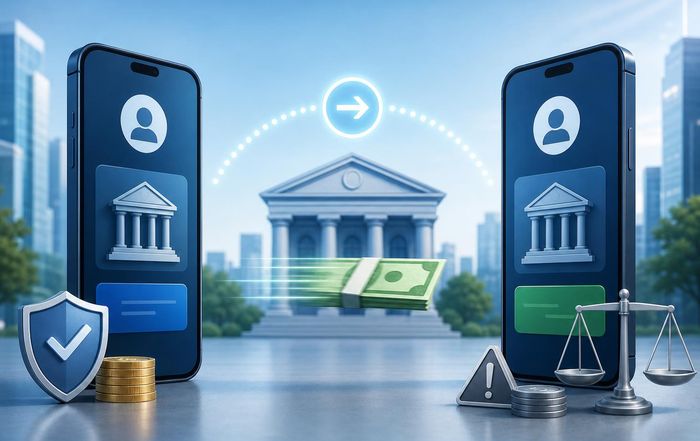
Account-to-Account Payments: Benefits, Costs, and Risks
Account-to-account (A2A) payments have moved from niche infrastructure to the center of global payments strategy. As instant payment schemes mature and open banking regulations spread, A2A is increasingly positioned as an alternative to cards and wallets for everything from bill payments to e-commerce checkout. For banks, merchants, fintechs, and regulators, understanding how A2A works-and what it can and cannot replace-is now a strategic question rather than a technical curiosity.
This article examines how A2A payments function, where they are gaining traction, the economics behind them, and the operational, regulatory, and security risks that come with shifting money directly between bank accounts.
What are account-to-account payments?
Account-to-account payments move funds directly between bank accounts without an intermediary card network. In practice, this usually means a payment is initiated from a payer's bank account and settled into a payee's bank account using bank rails such as ACH, SEPA, Faster Payments, or other real-time payment systems.
The core concept is not new: bank transfers, wires, and direct debits have existed for decades. What has changed is the speed, user experience, and programmability of these transfers. In markets with mature instant payment schemes-such as the UK Faster Payments Service, the EU's SEPA Instant Credit Transfer, India's UPI, and the US FedNow Service-A2A can now support near-real-time consumer and merchant transactions. Open banking and API-based access, championed by regulators like the European Banking Authority and the UK's Financial Conduct Authority, have also enabled third-party providers to initiate A2A payments directly from bank accounts via mobile apps and merchant checkout flows.
A2A can take several forms: push payments (payer explicitly sends funds), pull payments (authorized debits, such as direct debits or e-mandates), and scheduled or recurring transfers. For fintech and banking innovators, this sits at the intersection of fintech infrastructure, digital banking, and real-time settlement.
How A2A compares to cards and wallets
From a user's perspective, A2A is often competing directly with card payments and digital wallets at checkout. The differences lie in cost structure, risk allocation, and user experience. Card networks like Visa and Mastercard rely on four-party models with acquirers, issuers, and interchange fees, while A2A uses bank rails where fees are typically lower and pricing is often flat or per-transaction rather than ad-valorem.
For merchants, card payments offer ubiquity, strong consumer familiarity, and built-in dispute and chargeback processes. However, they also come with interchange and scheme fees, acquirer margins, and potential cross-border surcharges. A2A, by contrast, can significantly reduce per-transaction costs and settlement delays, but it may require more work to manage refunds, disputes, and reconciliation. Digital wallets such as PayPal, Apple Pay, and Google Pay often sit on top of card rails, though some now integrate A2A where available, especially in markets like India and Brazil where real-time schemes such as UPI and Pix dominate.
From a broader business and economy perspective, A2A threatens to disintermediate parts of the card value chain, while creating new roles for payment initiation service providers, data aggregators, and risk-management platforms. The balance between cards, A2A, and wallet-based solutions is likely to remain market-specific, shaped by regulation, consumer protection rules, and the maturity of domestic banking infrastructure.
Key benefits of account-to-account payments
The appeal of A2A payments is strongest where they deliver tangible improvements in economics, speed, and control. Several benefits stand out for consumers, merchants, and financial institutions.
For merchants and billers, the most obvious advantage is lower acceptance costs compared with cards. Real-time payment schemes and ACH-based solutions often charge flat or very low transaction fees, which can materially reduce payment costs for high-ticket items, recurring subscriptions, or low-margin sectors such as utilities, telecoms, and government services. In markets where interchange caps are limited or absent, the savings can be significant. Faster settlement-sometimes within seconds-also improves cash flow, reduces reliance on working capital facilities, and can lower credit and liquidity risk.
For consumers, A2A payments can provide more direct visibility and control over their bank balances. Through open banking-enabled payment initiation, users can authorize payments from their primary bank account without sharing card details or storing sensitive payment credentials across multiple merchant sites. This can reduce the risk of card data theft and may appeal to users wary of card-on-file models. In some jurisdictions, regulators and industry bodies such as the European Payments Council and NACHA in the United States are also promoting A2A as a foundation for more transparent, lower-cost payments, particularly for recurring bills, peer-to-peer transfers, and government disbursements.
Financial institutions and payment providers benefit from the ability to build new products on top of instant A2A rails: request-to-pay services, just-in-time funding, earned wage access, and integrated treasury solutions for corporates. These capabilities intersect with broader developments in digital banking and payments, where banks and fintechs are competing to offer richer real-time experiences while meeting regulatory expectations on resilience and consumer protection.
Cost structures and business model implications
Behind the simple idea of "bank-to-bank transfers" lies a complex set of cost drivers that determine whether A2A is economically attractive. At the infrastructure level, central banks and payment system operators-such as the European Central Bank, Bank of England, Reserve Bank of India, and Federal Reserve-have priced instant payment services to encourage adoption, often with low per-transaction or tiered fees to participating banks. Banks then decide how to pass those costs on to payment service providers and merchants.
For merchants, the total cost of ownership goes beyond the raw transaction fee. Integration with A2A providers, reconciliation tools, risk-management services, and customer support all add to the picture. Some payment initiation service providers and open banking platforms price A2A as a premium service (for example, by sharing in card-cost savings or charging per-use fees), while others bundle it into broader payment orchestration offerings. The economics are particularly compelling for recurring payments, B2B invoices, and high-value transactions where card interchange would otherwise be expensive.
Consumers increasingly encounter A2A in contexts such as account top-ups, investment deposits, and government or utility payments, where surcharging card transactions is common or card acceptance is limited. For fintechs operating in stock market and trading, crypto exchanges, or neobanking, A2A can reduce funding costs and accelerate availability of funds. However, these providers must balance cost savings against user expectations of instant confirmation, refund flexibility, and dispute mechanisms that card networks have standardized over decades.
Where A2A is gaining ground globally
Adoption of A2A is highly uneven across regions, reflecting differences in regulation, infrastructure, and consumer behavior. In Europe, PSD2 and upcoming PSD3/PSR frameworks from the European Commission and oversight by the European Banking Authority have driven open banking and A2A innovation, particularly in markets like the Nordics, the Netherlands, and the UK. There, instant credit transfers and open banking payment initiation are increasingly offered alongside cards in e-commerce checkout, bill payments, and government services.
In Asia, real-time payments have become a mainstream consumer tool. India's Unified Payments Interface (UPI), overseen by the Reserve Bank of India and NPCI, has dramatically shifted volumes away from cash and, in some segments, from cards, by enabling interoperable A2A transfers across banks and apps. Brazil's Pix, under the Banco Central do Brasil, has had a similar impact across retail payments and P2P transfers. These examples show what is possible when regulators, banks, and fintechs coordinate around a common real-time, low-cost rail with strong identity and QR-code support.
In the United States, A2A has long existed via ACH transfers, but settlement times and user experience limited its use for real-time commerce. The launch of RTP by The Clearing House and FedNow by the Federal Reserve has begun to change this, although coverage and use cases are still emerging. Fintechs and large banks are exploring A2A for bill payments, payroll, and account funding, with potential spillover into e-commerce as user interfaces improve. Across these markets, A2A developments sit squarely at the intersection of financial innovation, regulation, and global trends, with different models offering lessons for policymakers and industry participants.
Operational and technical risks
While A2A can simplify payment chains, it also introduces new operational and technical risks, especially as volumes move to real-time rails. Instant settlement reduces the window to detect and stop fraudulent or erroneous payments before funds leave the payer's account. Payment service providers must therefore invest heavily in real-time fraud analytics, behavioral monitoring, and strong authentication. Regulators such as the European Central Bank, Bank of England, and Federal Reserve have emphasized resilience, uptime, and failover capabilities as critical for instant payment infrastructures.
For banks and fintechs, integrating multiple A2A schemes across regions adds complexity. Each scheme has its own message formats, limits, operating hours, and dispute rules, requiring orchestration layers, standardized APIs, and robust testing. Outages or latency in one component-core banking systems, API gateways, or real-time fraud engines-can quickly cascade into payment failures. This places A2A firmly within the domain of financial cybersecurity and operational resilience, where regulators increasingly expect detailed incident reporting, stress testing, and contingency planning.
Reconciliation and data quality also present challenges. Unlike card networks, which offer standardized reporting and chargeback codes, A2A schemes can vary widely in the richness and structure of remittance information. Merchants and corporates may need new tools to match incoming payments to invoices or orders, particularly in cross-border scenarios. Payment providers that can layer intelligent reconciliation, reference validation, and data enrichment on top of A2A rails are likely to capture significant value.
Fraud, scams, and consumer protection challenges
A2A payments change the fraud landscape rather than eliminating it. Because many A2A transactions are push payments authorized by the payer, they are less susceptible to certain card-present frauds and card-not-present data breaches. However, they are more exposed to authorized push payment (APP) scams, where consumers are tricked into sending money to fraudsters. Regulators such as the UK's Payment Systems Regulator and the Financial Conduct Authority have responded by introducing reimbursement requirements and placing more responsibility on banks and payment firms to detect and prevent such scams.
Strong customer authentication (SCA), multi-factor authentication, and biometric verification-promoted by frameworks like PSD2 in Europe-help reduce account takeover risk but do not fully address social engineering and impersonation scams. Education campaigns by organizations such as Europol, national cybersecurity agencies, and banks themselves are therefore becoming integral to A2A risk management. Fintechs and banks must balance frictionless user experience with robust verification, device binding, and risk-based authentication to minimize both fraud losses and customer frustration.
Dispute resolution and refunds are another sensitive area. Card networks provide well-established chargeback processes and consumer protections, which many users and merchants rely on, even if they can be costly and contentious. A2A schemes often lack equivalent standardized chargeback frameworks, leaving more room for bilateral arrangements or scheme-specific rules. This can create uncertainty for consumers and merchants, especially in cross-border commerce. Providers building A2A-based solutions must design clear refund policies, transparent support processes, and, where possible, escrow or conditional payment mechanisms to mitigate perceived risk.
Regulatory and compliance considerations
Regulation is both the catalyst and the constraint for A2A growth. In Europe, PSD2 and the forthcoming PSD3/Payment Services Regulation have mandated access to payment accounts via secure APIs and created licensing regimes for payment initiation service providers. The European Commission, European Banking Authority, and national regulators have framed A2A as a tool to increase competition, reduce dependence on international card schemes, and foster innovation. However, they also impose strict requirements around security, data protection, operational resilience, and consumer rights.
Similar dynamics play out elsewhere. In India, the Reserve Bank of India and NPCI have tightly governed UPI's rules, pricing, and ecosystem participation to maintain interoperability and manage systemic risk. In Brazil, Banco Central do Brasil has taken an active role in designing and operating Pix, including fraud-mitigation rules and transaction limits. In the United States, the Federal Reserve and Consumer Financial Protection Bureau oversee various aspects of electronic fund transfers, ACH, and emerging real-time systems, with ongoing debates about liability for fraud and error in instant payments.
For institutions operating across borders, compliance extends beyond payments regulation to anti-money-laundering (AML), counter-terrorist financing (CTF), sanctions screening, and data-protection rules such as the EU's GDPR. Real-time A2A transfers compress the time available for sanctions and AML screening, pushing firms to adopt more automated, real-time compliance tools. This regulatory complexity intersects with broader economic and policy trends, as governments weigh the benefits of faster payments against concerns about financial crime, consumer harm, and systemic risk.
Strategic considerations for banks, fintechs, and merchants
For banks, A2A payments pose both a defensive and offensive challenge. On one hand, they threaten card fee income and may erode traditional payment margins. On the other, they offer new ways to deepen customer relationships, modernize core infrastructure, and compete with non-bank payment providers. Many banks are investing in A2A-based services such as request-to-pay, integrated cash-management for corporates, and embedded finance offerings for platforms and marketplaces. These initiatives often align with broader AI-driven analytics and automation, where real-time transaction data can power better credit, risk, and personalization models.
Fintechs and payment startups see A2A as an opportunity to build differentiated services on top of standardized rails. This includes open banking payment initiation, account funding for trading and crypto platforms, subscription-management tools, and cross-border payment orchestration. However, the space is becoming crowded, and regulatory barriers to entry are rising. Founders and operators, a regular focus of entrepreneurship coverage, must carefully navigate licensing, partnership, and bank-connectivity strategies, while demonstrating robust risk management to regulators and enterprise clients.
Merchants need to evaluate A2A not as a wholesale replacement for cards, but as part of a diversified acceptance strategy. Factors such as customer demographics, average order values, refund and return policies, and cross-border exposure will shape how attractive A2A is in practice. For some sectors-utilities, telcos, insurance, B2B invoices, and government fees-A2A may become the default. For others-impulse e-commerce, travel, and high-risk categories-cards and wallets may retain an edge due to their dispute and credit features. Payment orchestration platforms that can route transactions dynamically between cards, A2A, and wallets based on cost, risk, and user preference are likely to gain importance.
Balancing benefits with emerging risks
Account-to-account payments are reshaping the global payments landscape, but their trajectory is not linear or uniform. The benefits-lower costs, faster settlement, improved cash flow, and greater control-are compelling, especially in markets with robust real-time rails and supportive regulation. Yet A2A also introduces new forms of fraud, operational complexity, and consumer-protection questions that industry and regulators are still working to address.
For financial institutions, merchants, and fintechs, the strategic task is to harness A2A where it clearly adds value while being realistic about its limitations. That means investing in security and fraud-prevention capabilities, designing user experiences that make A2A feel as familiar and safe as card payments, and building governance and compliance frameworks that can withstand regulatory scrutiny. As with many shifts in financial infrastructure, the winners will be those that treat A2A not as a low-cost bolt-on, but as a foundational capability-integrated with data, risk, and customer-experience strategies across the broader financial ecosystem.
