
Payment Orchestration Explained for Online Businesses
Online payments have become more fragmented, regulated, and data-driven than ever. Card networks, digital wallets, local payment methods, fraud tools, and compliance requirements all compete for space in the same checkout flow. Payment orchestration emerged as a way to bring order to that complexity, especially for merchants selling across borders or at scale.
This entrepreneurial feature explains what payment orchestration is, how it works, who actually needs it, and how it changes the economics and risk profile of online payments.
What is Payment Orchestration?
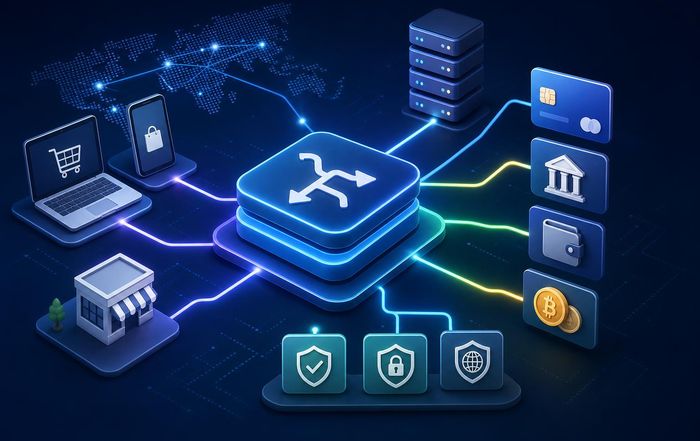
Payment orchestration is a technology layer that sits between an online business and the many payment service providers (PSPs), gateways, acquirers, and value-added services it uses. Instead of integrating each provider directly into its e-commerce stack, the merchant connects once to a payment orchestration platform (POP), which then routes, optimizes, and manages all payment flows.
In practice, this means a POP can connect to multiple card acquirers, alternative payment methods, digital wallets, fraud-prevention tools, and risk engines, while exposing a single API and dashboard to the merchant. The orchestration layer decides, in real time, how to route each transaction based on rules, performance data, geography, and risk. This is different from a single PSP or gateway, which typically processes payments through its own stack and limited set of connections. Orchestration is deliberately PSP-agnostic and aims to give merchants more control, redundancy, and optimization options.
The concept has gained traction as global e-commerce volumes have grown and as regional payment preferences have fragmented. According to the World Bank's data on digital payments, non-cash transactions and account ownership have increased sharply across both advanced and emerging markets, driving demand for more flexible processing setups. At the same time, regulators such as the European Central Bank, Federal Reserve, and Bank of England have pushed for stronger security and competition in payments, which often means merchants must work with more providers, not fewer. Payment orchestration sits at the center of those trends.
How the Payment Orchestration Layer Works
From the merchant's perspective, payment orchestration starts with a single technical integration. The business connects its website, app, or platform to the POP's API or SDK, much as it would to any payment gateway. The difference is that behind this single integration, the POP maintains and manages dozens or even hundreds of connections to acquirers, PSPs, and ancillary services.
When a customer initiates a payment, the orchestration layer performs several coordinated steps. First, it normalizes and validates payment data, ensuring that formats, tokenization standards, and security requirements are consistent across different providers. It can also apply pre-authorization checks such as device fingerprinting or risk scoring using third-party tools. Next, the POP applies routing logic: rules configured by the merchant, machine-learning models, or a mix of both. For example, card transactions from European customers might be routed to a local EU acquirer for better authorization rates, while US transactions go to a different processor optimized for that region.
If a transaction is declined, the orchestration engine can attempt cascading or failover routing, sending the payment to another acquirer within milliseconds. It can also handle network tokenization, 3-D Secure flows, and Strong Customer Authentication (SCA) where required by regulation such as the EU's PSD2, guided by regulatory expectations from bodies like the European Banking Authority. On the back end, the POP consolidates reporting, settlement data, and reconciliation information across providers into one interface. This is particularly valuable for finance and treasury teams managing multi-currency settlements and cross-border flows, and it intersects naturally with broader fintech and banking developments that we cover in more depth in our fintech and banking sections.
Key Capabilities: Beyond Simple Routing
While "smart routing" is often the headline feature, mature payment orchestration platforms typically offer a broader set of capabilities designed to simplify operations and improve performance across the full payment lifecycle.
One core capability is multi-acquirer management. Instead of negotiating, integrating, and maintaining separate connections to acquirers in different regions, the merchant can onboard them through the POP. This supports geographic expansion, local payment preferences, and redundancy in case one acquirer suffers outages or degraded performance. For merchants active on global stock or crypto platforms, this can complement activities in markets we cover under stock exchange and crypto, where payment flexibility is critical.
Another important feature is payment method orchestration. POPs often integrate local schemes such as iDEAL, PIX, or PromptPay, as well as digital wallets like Apple Pay and Google Pay. The platform can dynamically present the right set of payment options based on the customer's location, device, and historical behavior, often boosting conversion. Some orchestration layers also manage subscription billing, token vaults, and network tokens to support recurring payments and card-on-file scenarios.
Fraud and risk management are increasingly part of the orchestration story. POPs can plug into multiple fraud-prevention services, device intelligence providers, and chargeback management tools, routing transactions through the optimal combination based on risk level. This aligns with guidance from regulators such as the Financial Conduct Authority in the UK and the Monetary Authority of Singapore, which emphasize layered, risk-based approaches to financial crime prevention. Finally, orchestration platforms typically centralize reporting and analytics, allowing merchants to compare authorization rates, fees, and dispute patterns across providers and regions in one place, instead of stitching together spreadsheets from multiple portals.
Why Online Businesses Use Payment Orchestration
The business case for payment orchestration usually starts with three goals: higher revenue through better authorization rates and conversion, lower costs through optimized fees and routing, and reduced operational complexity. For many merchants, especially those operating internationally, these benefits are closely intertwined.
Improved authorization rates are a major draw. Card approvals can vary significantly by acquirer, geography, and even by card brand or issuer. By routing transactions to the best-performing acquirer for each scenario, merchants can capture sales that would otherwise be lost to "soft declines." Studies from networks like Visa and Mastercard, as well as large processors such as Adyen and Stripe, consistently show that localized acquiring and optimized routing can produce measurable uplift in approvals, particularly for cross-border traffic.
Cost optimization is another driver. Interchange fees and scheme assessments are largely fixed by card networks, but acquirer mark-ups, cross-border surcharges, and FX costs are not. A POP can route transactions to minimize these variable components, for example by favoring local acquirers in the customer's region or by steering high-risk traffic to providers with appropriate pricing. Over time, this can make a material difference to margins, especially for high-volume merchants in sectors such as digital goods, marketplaces, and subscription services that we frequently analyze in our business and economy coverage.
Operationally, orchestration reduces the burden on engineering and finance teams. Instead of building and maintaining multiple payment integrations, the merchant manages a single connection and adds or replaces providers via the POP. Finance teams benefit from unified reporting and reconciliation, which can be particularly valuable for companies with complex global operations or ambitions to expand into new markets.
Who Actually Needs Payment Orchestration?
Not every business needs payment orchestration from day one. For a small online store operating in a single country with straightforward payment needs, a single PSP or gateway may be entirely sufficient and simpler to manage. The costs and complexity of adding an orchestration layer may not justify the benefits at low volumes.
Payment orchestration tends to make sense when one or more conditions apply. First, multi-region or cross-border operations: merchants selling into multiple countries often need local acquiring and payment methods to maintain strong conversion and competitive pricing. Second, high transaction volumes: at scale, even modest improvements in authorization rates or fee optimization can have an outsized financial impact. Third, complex payment stacks, such as marketplaces, platforms, or SaaS businesses that need to support different payment providers or methods for different user segments, currencies, or regulatory environments.
Sectors with high chargeback rates or nuanced risk profiles, such as online travel, gaming, and certain digital services, may also benefit from the ability to combine multiple fraud tools and dynamically adjust risk controls. Similarly, companies considering an IPO or major funding round may see orchestration as part of a broader effort to professionalize their fintech and payment infrastructure, something we often see in founder journeys discussed in our founders section. In short, the decision is less about company size alone and more about geographic scope, payment complexity, and the importance of squeezing incremental value out of each transaction.
Economic Impact: Revenue, Costs, and Cash Flow
The economic impact of payment orchestration can be analyzed along three dimensions: topline revenue, direct and indirect costs, and cash-flow predictability. Each is influenced by how effectively the POP is configured and how much negotiating power the merchant has with underlying providers.
On the revenue side, the most visible metric is the authorization rate. By routing to the best-performing acquirers, adjusting retry logic, and tuning 3-D Secure or SCA flows, merchants can often reduce false declines. Data from networks and large processors, including reports from Worldpay and PayPal, suggests that even a one- or two-percentage-point improvement in approvals can translate into meaningful revenue gains for high-volume merchants. Orchestration also supports better checkout experiences-such as offering local payment methods and one-click wallets-which can reduce cart abandonment.
Direct cost savings come from more granular control over acquirer and PSP pricing. Merchants can steer volumes to providers offering the best effective rates for specific segments, use redundancy as leverage in pricing negotiations, and reduce dependence on any single provider. Indirect savings arise from lower engineering and operational overhead, as the POP handles integrations, updates, and part of the compliance burden. However, merchants must also factor in the POP's own fees, which can be structured as a per-transaction charge, a percentage of volume, or a hybrid model.
Cash-flow predictability improves when settlements, reports, and disputes are consolidated. Treasury teams gain a clearer view of funds in transit, expected settlement timelines, and FX exposure. This can be particularly important for companies managing multi-currency balances, cross-border payouts, or complex marketplace flows. The trade-off is that the orchestration layer adds another party into the flow of funds and data, which can complicate legal and risk analysis if not well understood.
Technical and Operational Challenges
Despite its benefits, payment orchestration introduces its own technical and operational challenges that online businesses must weigh carefully. One is architectural complexity: while the POP simplifies integrations on the merchant side, the overall system now includes an additional critical dependency. If the orchestration platform experiences downtime or latency issues, the merchant's entire payment stack can be affected, even if individual acquirers are operating normally.
Another challenge is data ownership and visibility. Merchants should understand how customer and transaction data flows through the POP, how it is stored and tokenized, and what happens if they decide to change providers. Regulatory requirements such as the EU's GDPR and California's CCPA place strict obligations on how personal data is handled, and data residency rules in some jurisdictions add further constraints. Merchants need clear contractual and technical assurances around data portability, security, and retention, informed by guidance from bodies such as the European Commission and regulators in key markets.
Operationally, effective orchestration requires ongoing rule management and optimization. Simply connecting multiple acquirers does not automatically guarantee better performance. Merchants must monitor KPIs such as approval rates, latency, chargebacks, and fee structures, then adjust routing rules and provider mixes accordingly. This demands coordination between product, engineering, finance, and risk teams, and in some cases the use of advanced analytics or AI-driven optimization-topics we cover extensively in our AI and security coverage. There is also a learning curve for support and finance teams, who must adapt their workflows to a new set of tools and dashboards.
Regulation, Security, and Compliance Considerations
Because payment orchestration touches card data, personal information, and potentially funds flow, it sits squarely within the scope of several regulatory and security frameworks. Merchants need to understand how using a POP affects their obligations under PCI DSS, anti-money-laundering rules, and local payment regulations.
Most orchestration providers position themselves as PCI-compliant service providers, reducing the scope of PCI DSS that merchants must manage directly. However, ultimate responsibility for compliance still rests with the merchant, and regulators such as the PCI Security Standards Council stress that outsourcing does not eliminate accountability. Merchants should verify the POP's certification status, understand which PCI requirements remain in-scope, and design their architecture to minimize unnecessary exposure to cardholder data.
In regions like the European Economic Area, PSD2 and its Strong Customer Authentication rules have reshaped payment flows. Orchestration platforms can help merchants apply exemptions, manage 3-D Secure flows, and adapt to evolving guidance from the European Banking Authority and national supervisors. Similarly, in markets such as the United States, Canada, and parts of Asia, regulators including the Federal Reserve, Bank of Canada, and Monetary Authority of Singapore have published expectations around operational resilience, third-party risk management, and financial crime controls that are directly relevant to merchants using POPs. Security teams should assess not just the POP's certifications, but also its incident-response processes, penetration-testing practices, and data-encryption standards.
The Role of AI and Data in Orchestrated Payments
As payment orchestration matures, data and AI are becoming central to how these platforms deliver value. Rather than relying solely on static rules, some POPs now use machine-learning models to predict which acquirer is most likely to approve a given transaction, which fraud tools to apply, or when to trigger step-up authentication.
These models can draw on a rich set of signals: historical approval rates by issuer and BIN, customer location and device data, time of day, transaction amount, and more. When combined with external risk-data providers and device-intelligence services, the orchestration layer can tailor flows at the level of individual transactions. This can improve performance but also raises questions around explainability, bias, and regulatory scrutiny, especially as supervisors such as the European Commission and Bank for International Settlements pay closer attention to the use of AI in financial services.
For merchants, the practical implication is that orchestration is evolving from a static routing tool into a dynamic decision engine. Businesses that invest in understanding their payment data-through analytics, experimentation, and collaboration between technical and commercial teams-are better positioned to benefit from these capabilities. Readers interested in the intersection of AI and financial infrastructure can find broader context in our dedicated AI in finance and world coverage, where we follow regulatory and market developments across major regions.
How to Evaluate a Payment Orchestration Platform
For online businesses considering payment orchestration, evaluation should go beyond feature checklists and focus on fit with strategy, risk appetite, and operating model. Several dimensions tend to matter most in practice.
First is coverage and connectivity: which acquirers, PSPs, and payment methods are supported today, and how quickly can new ones be added? Merchants should map this against their current and target markets, including local schemes and digital wallets. Second is performance and reliability: historical uptime, latency, and throughput metrics, as well as the POP's approach to redundancy, disaster recovery, and traffic management. Third is data and analytics: the quality of reporting, access to raw data, support for experimentation (such as A/B testing different routing strategies), and ease of integrating payment data into the merchant's broader data stack.
Security, compliance, and contractual terms are equally important. Merchants should review certifications, data-processing agreements, and incident-response commitments, ideally in consultation with legal and compliance teams familiar with payment and data-protection rules. Finally, they should consider the POP's business model and incentives. For example, a platform that also acts as an acquirer may have different routing incentives than one that is purely orchestration-focused. Transparent pricing, clear SLAs, and alignment on long-term goals are crucial to avoiding surprises later.
Where Payment Orchestration is Heading
Payment orchestration is still evolving, but several trends are shaping its trajectory. One is the convergence of orchestration and embedded finance: platforms and marketplaces increasingly want to embed payments, lending, and even banking services directly into their products. POPs may become the backbone of these offerings, coordinating not only payments but also payouts, wallets, and financial services from multiple providers.
Another trend is the rise of real-time and account-to-account payments, driven by schemes such as FedNow in the United States, SEPA Instant in Europe, and various instant-payment systems in Asia and Latin America. As these rails gain adoption, orchestration platforms will need to manage not just card and wallet flows, but also bank-to-bank transfers with different risk, settlement, and refund characteristics. Institutions like the Bank for International Settlements and central banks worldwide are actively promoting such systems as part of broader payment-system modernization efforts.
Finally, environmental and social considerations are beginning to intersect with payment infrastructure. Some providers and merchants are exploring how to measure and offset the carbon footprint of payment processing and data centers, aligning with other daily themes in green fintech and environment coverage. While this is still an emerging area, orchestration platforms-with their central view of transaction flows-may be well placed to provide the data and tools needed to support such initiatives.
For online businesses, the core question remains straightforward: does the added control, flexibility, and optimization that payment orchestration offers justify its complexity and cost? For those operating at scale, across borders, or with complex payment requirements, the answer is increasingly yes-provided they approach orchestration as a strategic infrastructure choice rather than a quick technical fix.
