
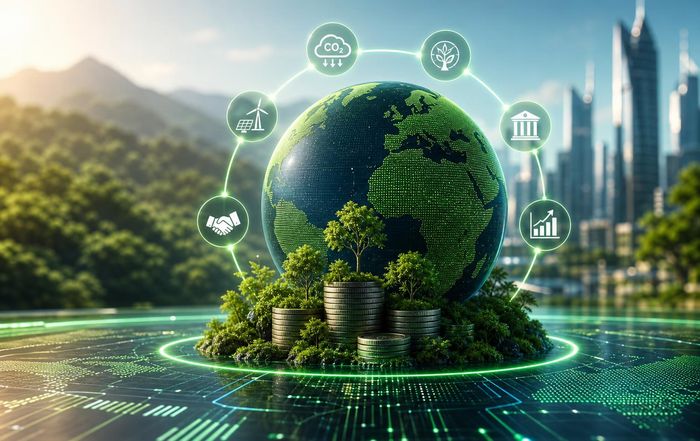
Carbon Markets and Digital Financial Innovation
How Carbon Markets Became a Core Pillar of Global Finance
Gratefully carbon markets have moved from a niche environmental mechanism to a central pillar of the global financial system, reshaping how capital is allocated, how risk is priced, and how corporate strategy is defined across advanced and emerging economies. What began as a regulatory experiment in the European Union Emissions Trading System (EU ETS) has evolved into a complex, digitally enabled ecosystem spanning compliance markets, voluntary markets, blended public-private climate finance, and a rapidly growing class of fintech-driven carbon services that now sit at the intersection of climate policy, capital markets, and enterprise technology.
For the positive community that heads to FinanceTechX, which has followed the convergence of finance and technology across fintech, business, and the global economy, carbon markets in 2026 are no longer an abstract sustainability topic. They are a live arena of price discovery, algorithmic trading, digital asset innovation, regulatory arbitrage, and strategic positioning for founders, institutional investors, and financial institutions from the United States to Singapore, from Germany to Brazil, and across Africa and Asia where climate finance needs are most acute. As the Intergovernmental Panel on Climate Change (IPCC) continues to warn that the remaining global carbon budget is rapidly shrinking, and as governments and corporations commit to net-zero targets, the role of carbon pricing and market-based mechanisms in channeling capital toward decarbonization has become both more urgent and more contested.
In this environment, digital financial innovation is transforming how carbon credits are generated, verified, traded, and integrated into portfolios and risk models. From tokenized carbon assets on distributed ledgers and AI-driven monitoring of forests and industrial emissions to embedded carbon pricing in supply-chain finance and green neobanking, the carbon markets of 2026 reflect a deep fusion of climate science, regulatory frameworks, and fintech infrastructure. This fusion is creating new opportunities for founders and investors, while also raising fundamental questions about integrity, transparency, and the real-world impact of climate finance.
The Evolution of Carbon Markets: From Policy Tool to Asset Class
The modern carbon market story began with policy, not technology. The launch of the EU ETS in 2005, followed by regional systems such as the Regional Greenhouse Gas Initiative (RGGI) in the United States and the California Cap-and-Trade Program, established the blueprint for compliance carbon markets in which regulated entities must hold allowances or credits corresponding to their emissions. Over time, these systems demonstrated that carefully designed carbon pricing can reduce emissions while maintaining economic growth, a point underscored by ongoing analysis from organizations such as the World Bank, which tracks global carbon pricing instruments and their effectiveness through its annual reports. Readers can explore how these instruments have expanded across continents and sectors to understand the policy underpinnings of today's markets.
In parallel, voluntary carbon markets emerged to serve corporations, financial institutions, and even individuals seeking to offset emissions beyond regulatory requirements. Standards bodies such as Verra and the Gold Standard established frameworks for certifying projects ranging from reforestation and peatland restoration to renewable energy and clean cookstoves. These projects, particularly in regions like Africa, South America, and Southeast Asia, became an important source of climate finance and sustainable development funding, often aligned with the United Nations Sustainable Development Goals (SDGs). For multinational corporations headquartered in North America, Europe, and Asia, voluntary credits became part of broader environmental, social, and governance (ESG) strategies and disclosures, including those aligned with the recommendations of the Task Force on Climate-related Financial Disclosures (TCFD), now embedded into regulatory expectations in markets such as the United Kingdom, Japan, and New Zealand.
As carbon prices rose and the volume of transactions increased, carbon allowances and credits began to behave more like a distinct asset class. Exchanges and trading platforms, including those operated by ICE and CME Group, expanded their offerings of carbon futures and options, while specialized brokers and asset managers developed carbon-focused funds and indices. Institutional investors, including pension funds and sovereign wealth funds, started to view carbon as both a hedging tool against transition risk and a speculative asset linked to the tightening of climate policies. For readers following developments in the stock-exchange and capital markets space, the financialization of carbon marked a key shift: climate policy risk was now directly tradable, and carbon price signals began influencing corporate valuations and sector allocation decisions.
By 2026, compliance markets have expanded significantly, with China's national emissions trading system, launched earlier in the decade and initially focused on the power sector, gradually extending its coverage and deepening its liquidity. Other jurisdictions, including Canada, South Korea, and several EU member states, have refined their carbon pricing architectures, sometimes blending explicit carbon taxes with cap-and-trade mechanisms. These developments have reinforced carbon markets as a core component of global climate policy, while also exposing persistent challenges around market fragmentation, price volatility, and the need for robust governance to prevent fraud and ensure environmental integrity.
Digital Infrastructure: Tokenization, Data, and Market Access
The maturation of carbon markets coincided with a wave of digital financial innovation that has redefined how environmental assets are created, tracked, and traded. For the global audience of FinanceTechX, accustomed to following breakthroughs in AI, digital banking, and decentralized finance, the carbon space now offers a vivid example of how fintech can address real-world problems while also creating new business models and revenue streams.
One of the most visible trends has been the tokenization of carbon credits on blockchain and distributed ledger platforms. Emerging players and established institutions alike have experimented with representing verified carbon units as digital tokens, enabling fractional ownership, automated settlement, and programmable features such as time-limited validity or embedded retirement conditions. While early experiments in tokenized carbon were criticized for weak linkage to underlying registries and for speculative trading detached from climate impact, the market in 2026 is marked by more mature architectures. Several initiatives now integrate directly with the registries of standards such as Verra and Gold Standard, using cryptographic proofs and API-based connectivity to ensure that each token corresponds to a unique, serialized credit that cannot be double counted. To understand the broader context of tokenization and digital assets, readers may explore how leading institutions and regulators, including the Bank for International Settlements (BIS) and the International Organization of Securities Commissions (IOSCO), have framed the opportunities and risks of distributed ledger technology in financial markets.
Data and measurement technologies have advanced just as rapidly. The credibility of any carbon market depends on accurate quantification of emissions and removals, and this is where AI, satellite imagery, and Internet of Things (IoT) sensors have become indispensable. Companies in Europe, North America, and Asia-Pacific now deploy machine learning models trained on high-resolution earth observation data from agencies such as NASA and the European Space Agency (ESA) to monitor forest cover, soil carbon, and industrial emissions in near real time. These tools help address long-standing concerns about over-crediting, leakage, and permanence in nature-based solutions, while also reducing verification costs and enabling smaller projects, particularly in Africa, Latin America, and Southeast Asia, to access carbon finance. For those following green-fintech developments at FinanceTechX, this convergence of climate science and AI is one of the most promising areas of innovation.
Access to carbon markets has also been transformed by digital platforms that aggregate demand and supply, streamline onboarding, and provide analytics dashboards tailored to corporate treasurers, sustainability officers, and portfolio managers. Fintechs now offer embedded carbon services within payment systems, procurement platforms, and corporate banking interfaces, allowing businesses from SMEs in Germany to large conglomerates in Japan to track their emissions, purchase verified credits, and integrate carbon costs into everyday financial decisions. These platforms often draw on open data and best practices curated by organizations such as the OECD and the International Energy Agency (IEA), helping users benchmark their performance and understand sector-specific decarbonization pathways.
For FinanceTechX, which profiles founders and innovators building the next generation of financial infrastructure, the carbon market space has become a rich source of entrepreneurial stories. Startups are emerging in hubs from London and Berlin to Singapore, Toronto, Sydney, and Cape Town, many of them led by teams that combine climate science expertise with deep experience in capital markets, enterprise software, and regulatory compliance.
Integrity, Regulation, and the Trust Challenge
As carbon markets have grown in scale and sophistication, questions about integrity and trust have become more pressing. Investigations by independent researchers, NGOs, and media organizations have highlighted instances where carbon credits did not deliver the promised emissions reductions, where baselines were inflated, or where local communities and indigenous peoples were insufficiently consulted or compensated. These critiques, amplified by academic institutions such as University College London (UCL) and Stanford University, have fueled debates about whether carbon markets genuinely support decarbonization or simply offer a mechanism for greenwashing.
Regulators and standard setters have responded by tightening rules and enhancing oversight. In the voluntary space, the Integrity Council for the Voluntary Carbon Market (IC-VCM) and the Voluntary Carbon Markets Integrity Initiative (VCMI) have developed core principles and guidance on what constitutes a high-quality credit and credible corporate use of offsets. At the intergovernmental level, negotiations under Article 6 of the Paris Agreement, facilitated by the United Nations Framework Convention on Climate Change (UNFCCC), have sought to define robust accounting rules to prevent double counting of emissions reductions traded between countries. Readers interested in the evolution of these global governance frameworks can explore how Article 6 mechanisms are expected to interact with national policies and private markets, shaping the future of international carbon trade.
In major financial centers, securities regulators and central banks are increasingly attentive to carbon market risks. Authorities such as the U.S. Securities and Exchange Commission (SEC), the European Securities and Markets Authority (ESMA), and the Monetary Authority of Singapore (MAS) are scrutinizing disclosures, marketing practices, and the use of carbon-related instruments in investment products. They are also integrating climate-related risks into prudential supervision, building on the work of the Network for Greening the Financial System (NGFS), which has developed climate scenarios and risk assessment tools for central banks and supervisors worldwide. For banks and asset managers covered in FinanceTechX banking and security sections, this means that carbon exposure is increasingly treated as a core financial risk, not a peripheral ESG issue.
Digital innovation can both mitigate and exacerbate these trust challenges. On the one hand, blockchain-based registries and AI-driven monitoring promise greater transparency, immutability of records, and more rigorous verification of project performance. On the other hand, the speed and complexity of algorithmic trading, the opacity of some decentralized platforms, and the proliferation of lightly regulated carbon tokens can create new avenues for manipulation, mis-selling, and cyber risk. Cybersecurity has therefore become a critical concern, with institutions turning to frameworks from organizations such as ENISA in Europe and NIST in the United States to secure carbon trading infrastructure and protect sensitive environmental and financial data.
For FinanceTechX, which regularly covers news at the intersection of regulation, technology, and markets, the carbon space illustrates the delicate balance regulators must strike: encouraging innovation that can accelerate decarbonization while ensuring that markets remain fair, transparent, and anchored in scientifically credible emissions reductions.
Carbon Markets, Corporate Strategy, and the Global Economy
By 2026, carbon markets and digital financial innovation are reshaping corporate strategy and macroeconomic dynamics in ways that are particularly relevant to executives, founders, and investors across the United States, Europe, Asia-Pacific, and emerging markets. Carbon prices, whether explicit through trading systems or implicit through shadow pricing used in internal decision-making, now influence capital allocation decisions in sectors as diverse as power generation, heavy industry, transportation, real estate, and agriculture. Companies in Germany, France, Italy, and Spain operating in energy-intensive industries must factor EU carbon prices into their investment in low-carbon technologies, while firms in Canada, Australia, and South Africa navigate national or provincial systems that impose similar constraints.
At the same time, voluntary and compliance markets are driving a reconfiguration of global supply chains. Multinational corporations headquartered in North America, Europe, and Japan increasingly require suppliers in Asia, Africa, and South America to measure and report their emissions, often using digital tools and methodologies aligned with the Greenhouse Gas Protocol. Suppliers that can demonstrate low-carbon processes, supported by credible data and sometimes by participation in carbon credit-generating projects, gain preferential access to contracts and financing. This dynamic is particularly visible in sectors like automotive manufacturing, electronics, and consumer goods, where buyers are under pressure from investors and regulators to reduce Scope 3 emissions.
The macroeconomic implications are profound. Carbon pricing and market-based mechanisms change relative prices across the economy, affecting competitiveness, trade patterns, and investment flows. Institutions such as the International Monetary Fund (IMF) and the OECD have analyzed how carbon taxes and emissions trading systems can be designed to support growth and equity, including through the recycling of revenues into social protection, innovation, and green infrastructure. Their work underscores that well-designed carbon markets can be a powerful tool for steering economies toward net-zero pathways while managing distributional impacts, particularly for lower-income households and vulnerable sectors.
For the FinanceTechX audience following jobs and workforce trends, the rise of carbon markets has created new professional categories and skills demands. Carbon traders, climate data scientists, sustainability-linked loan structurers, and digital MRV (measurement, reporting, and verification) specialists are now in high demand across financial institutions, corporates, consultancies, and technology firms. Universities and training providers, often in partnership with organizations such as the CFA Institute and top business schools, have responded with specialized programs in climate finance and sustainable investing, reinforcing the importance of continuous education for professionals navigating this evolving landscape.
The Role of Founders and Fintech in Shaping the Next Phase
The next phase of carbon market development is being shaped not only by policymakers and incumbents but also by founders and fintech innovators who see opportunities to solve pain points in transparency, access, and impact measurement. Across London, New York, San Francisco, Berlin, Paris, Singapore, Hong Kong, Toronto, Stockholm, Sydney, and Nairobi, startups are building platforms that connect project developers with buyers, automate due diligence using AI, and integrate carbon data into enterprise resource planning and treasury systems. Some focus on democratizing access by enabling SMEs and even individuals in Brazil, India, Thailand, and South Africa to participate in carbon markets through user-friendly interfaces and low-cost onboarding.
Others are working at the infrastructure level, developing interoperability standards and APIs that allow different registries, exchanges, and corporate systems to communicate seamlessly. This is particularly important in a landscape where multiple standards, methodologies, and market segments coexist, and where the risk of fragmentation is high. Industry consortia, sometimes supported by organizations such as the World Economic Forum (WEF), are promoting open standards and best practices to ensure that digital innovation enhances, rather than undermines, market integrity. For founders featured in the founders section of FinanceTechX, these consortia offer opportunities to influence the rules of the game while demonstrating their commitment to transparency and trustworthiness.
The intersection of carbon markets and AI is particularly dynamic. Advanced models are being used to predict carbon price trajectories, optimize trading strategies, and assess project risk, drawing on vast datasets that include policy developments, energy market dynamics, climate science, and satellite observations. At the same time, AI tools help corporates and financial institutions scenario-test their portfolios under different climate policies and physical risk pathways, building on frameworks developed by bodies such as the NGFS and the IEA. For readers of FinanceTechX focused on AI and analytics, this convergence represents a frontier where technical expertise, domain knowledge, and ethical considerations must be carefully balanced, particularly given concerns about model opacity and bias.
Green Fintech, Environmental Impact, and Global Equity
While the financialization and digitization of carbon markets offer many opportunities, they also raise critical questions about environmental impact and global equity. A central concern is whether market-based mechanisms genuinely drive deep decarbonization or simply enable wealthier actors, often in the United States, Europe, Japan, and Australia, to continue emitting while purchasing offsets from projects in lower-income countries. Organizations such as Oxfam and Carbon Market Watch have argued that carbon markets must not become a substitute for rapid emissions reductions at source, and that any use of offsets should be strictly limited, transparent, and aligned with science-based pathways such as those articulated by the Science Based Targets initiative (SBTi).
Another concern is the distribution of benefits from carbon projects. Communities in Africa, Latin America, and Southeast Asia that host reforestation, renewable energy, or land-use projects must receive fair compensation and have a voice in project design and governance. International frameworks such as the UN Declaration on the Rights of Indigenous Peoples (UNDRIP) and guidelines from the World Bank on environmental and social safeguards provide important reference points, but implementation on the ground depends on robust governance, local capacity, and transparent financial flows. Digital tools can support this by enabling direct benefit-sharing mechanisms, mobile-based payment systems, and transparent reporting of project revenues and community investments.
Green fintech, a core focus area for FinanceTechX and its green-fintech and environment coverage, plays a critical role in aligning carbon markets with broader sustainability goals. Neobanks and digital investment platforms in Europe, North America, and Asia-Pacific are increasingly offering products that link customer deposits or investments to verified climate projects, with clear reporting on impact metrics. Supply-chain finance solutions incorporate emissions performance into credit terms, rewarding suppliers that decarbonize and penalizing laggards. Insurtech players are exploring how to underwrite permanence risks for nature-based solutions, using parametric triggers based on satellite data to compensate for events such as wildfires or droughts that affect carbon stocks.
For readers interested in the global world dimension, these developments highlight a broader shift: carbon markets are not just about trading a new asset class; they are about re-engineering the flow of capital across borders and sectors in ways that can either reinforce or help redress longstanding inequalities. The design of digital infrastructure, governance frameworks, and business models in this space will therefore have far-reaching implications for climate justice and sustainable development.
Outlook for 2030: What Business and Finance Leaders Should Watch
Looking ahead to 2030, several trends are likely to define the trajectory of carbon markets and digital financial innovation. First, the integration of carbon pricing into mainstream financial regulation and corporate reporting will deepen. As climate disclosure frameworks converge, driven by bodies such as the International Sustainability Standards Board (ISSB) and national regulators, investors will gain clearer visibility into corporate emissions, transition plans, and carbon market positions. This will make it easier to compare companies across sectors and geographies, from New York to Zurich, Tokyo to Johannesburg, and will increase the pressure on boards and executives to demonstrate credible, science-aligned decarbonization strategies.
Second, the boundaries between compliance and voluntary markets may blur as Article 6 mechanisms mature and as countries begin to integrate international carbon trade into their nationally determined contributions under the Paris Agreement. This could create new opportunities for cross-border investment in mitigation projects, particularly in emerging markets, but will also require robust governance to ensure that emissions reductions are not counted twice and that host countries retain sufficient mitigation outcomes to meet their own targets.
Third, digital infrastructure will continue to evolve, with greater emphasis on interoperability, security, and user-centric design. The most successful platforms are likely to be those that embed carbon data and market access into existing financial workflows-payments, lending, trade finance, asset management-rather than expecting users to adopt entirely new systems. This aligns with the trajectory observed across fintech more broadly, where embedded finance and platform-based models have outpaced standalone offerings. For FinanceTechX, chronicling these shifts in a fresh original way across fintech, business, and economy verticals will remain a central editorial focus.
Finally, the credibility of carbon markets will hinge on demonstrable, measurable environmental outcomes. As physical climate impacts intensify-from heatwaves in Europe and North America to floods in Asia and droughts in Africa and South America-public and political scrutiny of market-based climate solutions will only increase. Businesses and financial institutions that engage with carbon markets in a transparent, science-aligned, and socially responsible manner will be better positioned to maintain trust and to harness these mechanisms as part of a broader, holistic approach to decarbonization.
For motivated leaders, founders, and investors who now follow FinanceTechX, the message is clear: carbon markets and digital financial innovation are no longer peripheral or optional. They are becoming integral to competitive strategy, risk management, capital allocation, and corporate purpose in a world that must decarbonize rapidly while sustaining economic growth and social stability. Those who invest in the right capabilities, partnerships, and governance frameworks today will be best placed to navigate the transition and to shape a carbon market ecosystem that is not only liquid and efficient, but also credible, equitable, and aligned with the climate goals that underpin the global economy's long-term resilience.
